
BUFFER SOLUTION
Accessories
Accessories for pH IMPEDANCE SYSTEM
Buffer Solution
Buffer solutions play a crucial role in various scientific and industrial applications, particularly in maintaining stable pH levels. These solutions consist of a weak acid and its conjugate base or a weak base and its conjugate acid. Their primary function is to resist changes in pH when an acid or base is added to them, thereby stabilizing the pH of a system.
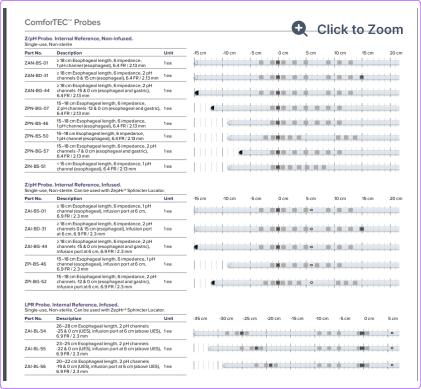
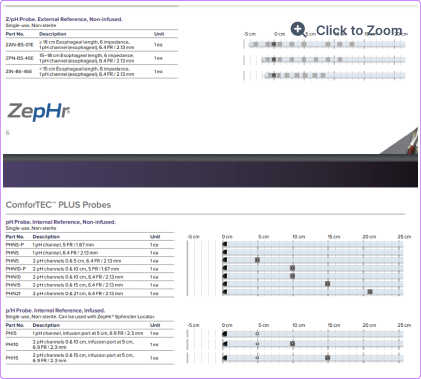
pH Probes
The widest range of standard probe configurations to meet your clinical needs for impedance/pH and pH-only studies Multiple sensor configurations available to accommodate a variety of study requirements and esophageal lengths Specially-formulated polyurethane, which softens in response to body temperature, optimizing ease of insertion and enhancing patient comfort Three probe sizes to detect full column and laryngopharyngeal reflux with positioning bands for precise placement just above the UES when a prior manometry study is not available
Accessories for MANOMETRY
CATHETERS
Esophageal catheters for manometry play a crucial role in diagnosing and assessing esophageal motility disorders. These catheters are thin, flexible tubes equipped with multiple pressure sensors, allowing for precise measurement of pressure changes along the length of the esophagus. During a manometry procedure, the catheter is inserted through the nose or mouth and advanced into the esophagus, where it records pressure readings as the patient swallows. This data helps clinicians evaluate the function of the esophageal muscles, sphincters, and coordination of swallowing, aiding in the diagnosis of conditions such as achalasia, esophageal spasms, and gastroesophageal reflux disease (GERD). Esophageal catheters for manometry provide valuable insights into esophageal physiology, guiding treatment decisions and improving patient outcomes.
SPECIAL FEATURES OF OUR CATHETERS
SILICON CATHETERS with a diameter of 3.2 mm for 16 channel and 5.2 mm for 24 channel
EXTREMELY THIN AND FLEXIBLE
EASY TO HANDLE AND MAINTAIN
AUTOCLAVABLE AS PER NABH NORMS
ANORECTAL CATHETER
Anorectal catheters for manometry play a crucial role in diagnosing and evaluating various anorectal disorders. These specialized catheters are designed to measure pressures within the rectum and anal canal, providing valuable insights into the functionality of the pelvic floor muscles and sphincters. By monitoring pressure changes during rest, squeeze, and push maneuvers, anorectal manometry helps clinicians assess conditions such as fecal incontinence, constipation, and rectal prolapse. The catheter insertion procedure, though minimally invasive, demands precision and expertise to ensure accurate readings.
BALLONS FOR ANORECTAL MANOMETRY
In some cases, balloons may be used as part of anorectal manometry to assess rectal sensation and compliance. These balloons are typically attached to the catheters and are inflated with air or water to varying degrees, allowing for the measurement of pressure and volume responses within the rectum.
The balloons used for anorectal manometry are typically small and soft to minimize discomfort for the patient during insertion and inflation. They are designed to be easily inserted into the rectum and anus and are disposable to ensure hygiene and prevent contamination between patients.
RADIO OPAQUE MARKERS FOR COLON TRANSIT STUDY
Radio opaque markers for colon transit study are a diagnostic tool used in gastroenterology to evaluate the motility and transit time of the colon. This procedure involves the ingestion of small, radio-opaque markers followed by imaging studies to track the movement of these markers through the gastrointestinal tract. The colon transit study is typically performed to assess various gastrointestinal disorders such as chronic constipation, colonic inertia, or irritable bowel syndrome (IBS). By observing the passage of radio-opaque markers through the colon, healthcare providers can identify abnormalities in transit time, which can help diagnose underlying conditions and guide treatment decisions. Over the course of several days, patients undergo imaging studies, such as X-rays or abdominal scans, at predetermined intervals. These imaging studies capture the movement of the markers through the gastrointestinal tract.Radio opaque markers for colon transit study offer several advantages over other diagnostic techniques. They provide a non-invasive and relatively simple method for evaluating colonic motility and transit time. Additionally, this procedure allows for repeated measurements over several days, enabling healthcare providers to assess the dynamic nature of colonic transit.